Objectives Link to heading
This page describes a set of rules and a methodology that, once applied to a system, can help you evaluate how well your system is regarding scalability and availability, can help you map your weaknesses and plan actions to improve them. In this context, scalability, availability and performance measured by low latency and high throughput are highly intertwined, as a high available system need to scale to be available regardless the load, a system with a high throughput scale more easily than one with a low throughput, and as a consequence is more available.
Vocabulary Link to heading
Scalability Link to heading
Citing the Wikipedia:
Scalability is the capability of a system, network, or process to handle a growing amount of work, or its potential to be enlarged to accommodate that growth. For example, a system is considered scalable if it is capable of increasing its total output under an increased load when resources (typically hardware) are added.
Availability Link to heading
Citing the Wikipedia:
The degree to which a system, subsystem or equipment is in a specified operable and committable state at the start of a mission, when the mission is called for at an unknown, i.e. a random, time. Simply put, availability is the proportion of time a system is in a functioning condition. This is often described as a mission capable rate. Mathematically, this is expressed as 100% minus unavailability.
The unavailability U of a system can be mathematically expressed as:
U = MTTR/(MTTR+MTTF)
Where:
MTTR is the Mean Time To Recover
MTTF is the Mean Time To Fail.
As an example, let’s suppose you have an application running in one machine in your datacenter, and your hardware provider told you the MTTF of this machine is 5 years. To recover from this failure, your application takes 30s to come alive again, counting the time to detect the failure, the time to instantiate a new virtual machine in another machine in your datacenter, and the time you application takes to startup (this is your MTTR).
So your availability A is:
A = 1 - U = 1 - (30/(30 + 5365246060)) = 1 - (30/(30 + 157680000)) = 0,999999809741284
Or in another words, you can expect approximately 6 hours of outage per year for your application.
An interesting fact that affects the availability is the probability one machine used by your system will fail is inversely proportional to the number of machine you use. So, in the example above, given a datacenter with 1000 machines (a relatively small datacenter) where each one has a MTTF of 5 years, you will have a machine failing more or less every 2 days.
Rules Review and Priorization Link to heading
Every time you don’t obey a rule in this page implies in a risk, and this risk can be defined as:
Risk = Probability * Impact
Where:
Impact = %Impact * (Downtime + %DataLoss + ResponseTimeImpact)
%Impact = %CustomersImpacted or %FunctionalityImpacted
By those terms it’s possible to define a prioritization table where for each rule, the priority is:
Priority = f(Risk Reduction, Cost of Solution)
The Risk Reduction and Cost of Solution are very specific for a organization/department/team. To make easier to evaluate a system, it’s simpler to give discrete values as High, Medium and Low for both variables, ariving to the following commutative table:
| Risk/Cost | Low | Medium | High |
|---|---|---|---|
| Low | Do it | Evaluate | Don’t do |
| Medium | Do it | Do it | Evaluate |
| High | Do it | Do it | Evaluate |
Rules Link to heading
We can split the process of activing high availabiliity in 3 dimensions: a horizontal scaling, splitting by function, service or resource and lookup/formulaic splits, arriving in the following cube representing the 3 variables relationship regarding the ideal near infinite scale:
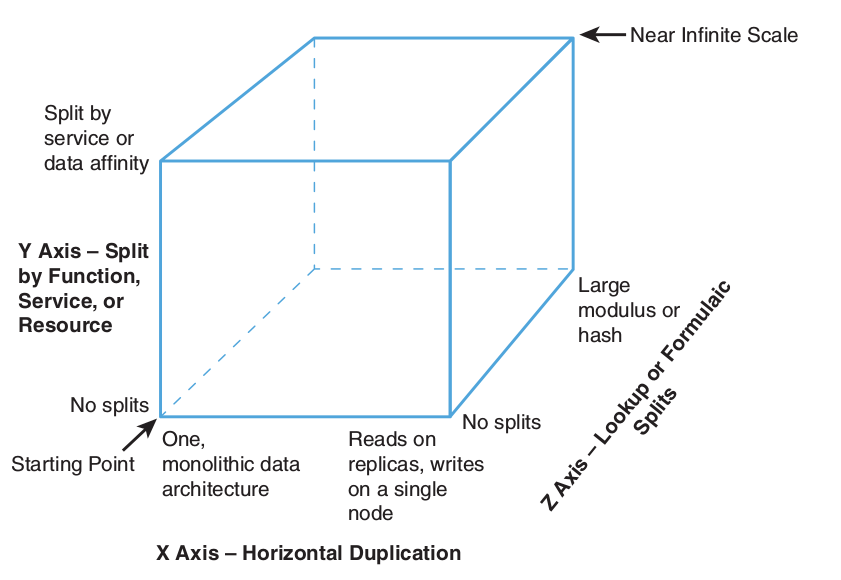
The rules are organized in main sections, and every rule has a short description and a resulting benefit/priority to the project. High priority rules normally are the ones with low cost and high risk, while low priority rules are the ones with high cost and low risk. The classification given by this document should be used as a starting point and adapted according to the project context.
The non-complaince to one of the rules normally means the project is accepting a risk in terms of scalability, and as such it’s needed a analysis cost/benefit. For real-time/critical systems the risk imposed by a low priority rule can be unnaceptable.
Reduce the Equation Rule Link to heading
Don’t overengineer the solution (High-2) Link to heading
Don’t build a solution for a problem bigger than the requirement.
Don’t do unnecessary work. Execute something only once.
Make it simple to other architects to understand.
Test: present the solution to a team of pairs
Design scale into the solution (Medium-3) Link to heading
D-I-D process:
Design for 20x capacity.
Implement for 3x capacity.
Deploy for 1.5x capacity.
Design have a low cost, design for 20x to infinity.
Implement considering 3x to 20x the capacity, consider the greatest bottleneck.
Simplify the solution 3 times over (Medium-3) Link to heading
Simplify scope using the Pareto principle. 80% of the revenue is achieved by 20% of the work.
Simplify design by thinking about cost effectiveness and scalability.
Do the same work faster and easier. Consider to join services together instead of multiple network trips to do the same job.
Simplify implementation by leveraging the experience of other, reuse open source, libraries from other departments, buy existing solutions or check for descriptions of a similar solution.
Reduce DNS lookups (Medium-3) Link to heading
Large number of user requests affects the user experience. DNS lookups contribute to slow down the application.
Reduce number of objects travelling the network (Medium-3) Link to heading
Check where your network is slower/faster and aggregate calls appropriately. The datacenter network is usually faster, so your protocol can be chatier here, but the last net hop to the user is usually slower.
Distribute your Work Link to heading
Design to clone or replicate things (High-2) Link to heading
Duplicate services/databases to spread the load.
Clone services and implement load balancers.
Database normalization and ACID properties make them difficult to split.
High read to write ratio allow read-only copies.
A layer of caching is a recommended first step.
Design to split different things (a.k.a domain-based microservices) (Medium-3) Link to heading
Split systems in nouns or verbs or both.
Separation using verbs: signup, login, search, browse, view, add-to-cart, purchase.
Separation using nouns: product catalog, product inventory, user account information, marketing information.
Design to split similar things (a.k.a sharding) (Medium-3) Link to heading
Identify a characteristic of your data and split or partition both data and services based on that attribute.
It’s possible to use some business related sharding, like per geographic location, by company size, by revenue. Or a simple modulus or hash function by user id.
When data for the same group of users is grouped together, bigger the chance for a cache hit.
Design to Scale Out Horizontally Link to heading
Design your solution to scale out, not just up (High-2) Link to heading
Allows for fast scale of transactions at the cost of duplicated data and functionality.
Don’t get caught in the trap of expecting to scale up to find out that you’ve run out of a faster and larger system to purchase.
Use commodity systems (High-2) Link to heading
Many smaller systems don’t suffer from inefficient sheduling algorithms, memory bus access speeds, structural harzards, data harzards.
Stay way from very large systems.
Allows for fast, cost-effective growth.
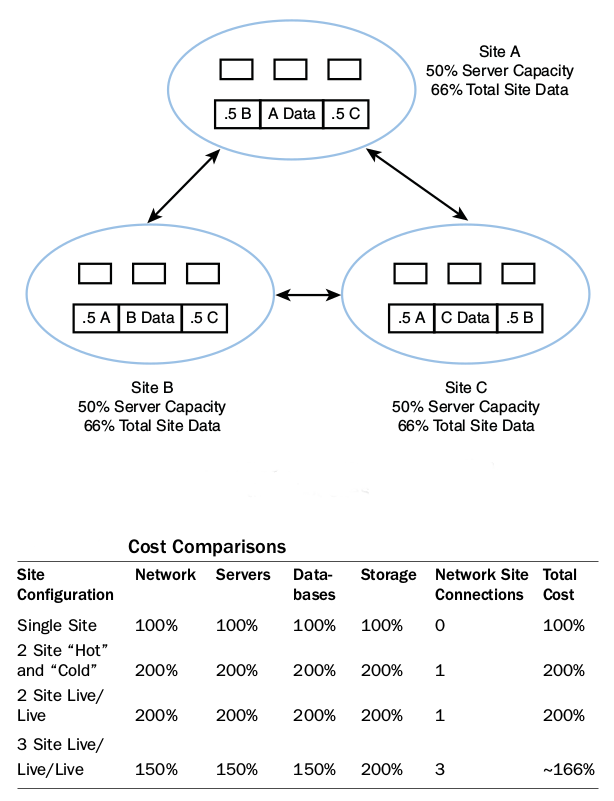
Scale out your data centers (Medium-3) Link to heading
Forget about hot-cold datacenters, they have more or less the same cost of operation and there’s a higher risk of failure when you finally need it.
Slice data between your datacenters to keep high availability. Spare some machine resource to distribute the load in case of failure.
E.g. given three datacenters:
Design to leverage the cloud (Low-4) Link to heading
Provision of hardware in the cloud takes few minutes.
Design to leverage virtualization in all sites and grow in the cloud to meet unexpected spiky demand.
BUT be carefull to not depend on specific cloud services to avoid a supplier lock-in. Or use it as a strategic advantage, but never do a blind choice.
Use the Right Tool Link to heading
Use the right database, and use it properly (High-2) Link to heading
Don’t use a SQL database where a noSQL database would work better.
Use the filesystem when possible.
Relationships give extra flexibility and guarantees but also extra costs to scale.
Reduce the numbers of firewalls (High-2) Link to heading
Use firewalls where they reduce risks, but be aware they cause issues with scalability and availability.
Don’t use for low value content.
Actively use log files (Medium-3) Link to heading
Use the application log to diagnose and prevent problems.
Implement a correlation ID to correlate logs from different services.
Put a process in place to monitor log files and force people to take action on issues.
Aggregate them, use log servers on out-of-band network.
Archive and purge as the value decreases.
Log in an asynchronous fashion.
Use Non-blocking I/O as much as possible (High-2) Link to heading
Serial, blocking I/O were the standard but are too expensive in high throuput systems.
Most of the Java Web servers use blocking I/O.
All the JDBC drivers use blocking I/O.
New options are reactive frameworks.
Don’t Duplicate your Work Link to heading
Don’t check your own work (Low-4) Link to heading
Don’t validate data you just wrote.
Keep data locally if you will immeadiately need it.
Stop redirecting traffic (Medium-3) Link to heading
Traffic redirections on the client side cause unecessary resource consumption.
Use server side redirection features instead.
Relax temporal constraints (Very High-1) Link to heading
Relax your temporal constraints, it’s hard to keep them and they are hardly necessary.
Use Cache Aggressively Link to heading
Leverage Content Delivery Networks (Medium-3) Link to heading
Wherever possible move static, semi-static or content that are not so dynamic to CDNs.
Use Expire Headers (Medium-3) Link to heading
Use the expire headers to inform the client or the CDN when a content should be considered stale.
Leverage application caches (Medium-3) Link to heading
Split the application to increase the cache hits by business terms, e.g. 80% of the requests occur against 20% of your inventory.
Premium users on their own servers.
Leverage object caches (Very High-1) Link to heading
On the application layer use caches, normally before your datastore.
Monitor the cache hit ratio, it should be around 80%.
Put object caches on their own “tier” (High-2) Link to heading
You will safe CPU and memory from the application layer.
Learn from your Mistakes Link to heading
Learn aggressively (High-2) Link to heading
Do A/B testing.
Employ a postmortem process:
Phase 1: Timeline
Phase 2: Issue identification
Phase 3: State actions, use SMART principle (every action should be specific, measurable, attainable, realistic and timely).
Every action need to have a single owner, even if executed by a group
Hypothesize failure:
No failure should stop in “server A died”, we need to find why the monitoring didn’t show the problem earlier, why the reaction was slow, why it took so long to recover, why the database is not split to reduce impact, etc…
Keep a log of failures and review them periodically to identify patterns.
Don’t rely on QAs to find mistakes (High-2) Link to heading
The QA know-how should be used to define the quality process and to keep memory of mistakes and recurring problems, help the engineering team to find root causes in the process.
Use TDD aggressively. Define and monitor a desired code coverage.
Failing to design for rollbacks is designing for failure (Very High-1) Link to heading
Ensure all releases have the ability to rollback, practice it on QA environment.
The cost is low, the risk is high.
Only additive database changes.
Database changes should be scripted and tested, including rollback scripts.
Use restricted SQL queries, don’t use SELECT * and add column names to UPDATE statements.
Avoid semantic changes of data.
The application should have a way to activate features for a limited number of users.
Database Rules Link to heading
Remove business intelligence from transaction processing (High-2) Link to heading
Don’t use stored procedures.
Easier to migrate to NoSQL down the road.
Easier to scale.
Business processes should not be tied to a single product.
Be aware of costly relationships (Medium-3) Link to heading
Relationships defines how costly is to retrieve data and how difficult would be to split the database.
New queries should be analyzed by DBAs.
To scale we may reduce normal forms.
A query join can be replaced by a view, a materialized view, a summary table to preprocess the query, or use the application to do the join.
Use the right type of database lock (Very High-1) Link to heading
Be aware of implicit locks and explicit ones.
Types of locks: implicit, explicit, row, page, extent, table, database.
Monitor your database to check if the correct lock is being deployed.
Employ read-only database nodes, denormalize and split databases.
Don’t use multiphase commits (High-2) Link to heading
Avoid 2 and 3 phase commits, they slowdown your application proportionally to the number of nodes on your cluster.
Don’t use SELECT FOR UPDATE (High-2) Link to heading
It adds locks and can slowdown transactions.
Some databases have by default cursors FOR UPDATE, check your documentation.
Don’t select everything with SELECT * (Very High-1) Link to heading
More probabble to break things if the table structure changes, and it will transfer unnecessary data.
Design for Fault Tolerance and Graceful Failure Link to heading
Design using fault-isolative “swim lanes” (Medium-3) Link to heading
Create fault isolation domains.
Nothing is shared between swim lanes, including the network, databases and servers.
No synchronous calls exists between swim lanes.
Limit asynchronous calls.
On asynchronous calls, you should be able to just ignore or no process now the response.
On a virtualized infra, keep all virtualized servers of a physical server in the same swim lane.
Tools and monitoring need to be fault tolerant as well, you don’t want to lose them when you require them the most.
Never trust single point of failure (High-2) Link to heading
Strive for active/active configurations.
Everything fails.
Avoid putting systems in series (Medium-3) Link to heading
Elements in series have a multiplicative effect on your probability of failure.
Don’t ignore network elements.
Ensure you can active/deactivate new features (Low-4) Link to heading
Use feature toggles and circuit breakers.
Implement when the cost is less than the risk = likehood * impact.
Avoid or Distribute State Link to heading
Strive for statelessness (Medium-3) Link to heading
Measure the need for state in terms of revenue and increased transactions.
Session and state cost money.
Maintain session data in the client when possible (High-2) Link to heading
Careful with sidejacking, trasfer an authorization cookie using https for example.
Make use of a distributed cache for states (High-2) Link to heading
Don’t implement systems that require affinity to function properly.
Don’t use state or session replication to create duplicates of data on different systems.
Don’t locate the cache on the system doing the work.
You can put your data in databases, non-persistent object caches and hybrid solutions.
Asynchronous Communications and Message Buses Link to heading
Communicate asynchronously as much as possible (High-2) Link to heading
On every external/third party API.
For long runnig processes.
On error prone/overly complex methods that change frequently.
When there’s no temporal constraint between two processes.
Ensure that your message bus can scale (High-2) Link to heading
Scale by service or message attribute.
Scale by customer, user, or site attribute.
Avoid overcrowding your message bus (High-2) Link to heading
Traffic isn’t free.
Sample traffic where possible.
Analyze the business value of every event.
Miscellaneous Link to heading
Be wary of scaling through third parties (Very High-1) Link to heading
You are a hostage of their SLAs.
They will not give you special treatment when there’s an incident.
Be aware of provider lock in.
A team exceptionaly can use a third party feature to speedup implementation, but should keep it as a technical debit.
Purge, archive and cost-justify storage (Medium-3) Link to heading
Match storage cost to data value.
Remove data with value lower than the cost to store it.
Use RFM: recency, frequency and monetization analisys
Partition Inductive, deductive, batch and user interaction (OLTP) workloads (High-2) Link to heading
Every type of iteraction deserves its own partition.
Design your application to be monitored (High-2) Link to heading
Prepare yourself to answer:
Is there a problem? (business oriented/customer centric metrics).
Where is the problem? (component/service level metrics)
What is the problem? (low level metrics)
Why is there a problem? (Posmortem)
Will be there a problem? (Last level, prediction)
Be competent (Very High-1) Link to heading
Know your tech, or have someone who knows.
Delegation is different from omission.
The client doesn’t care if it’s a supplier mistake, your are ultimatelly responsible.
Bibliography Link to heading
Scalability Rules: Principles for Scaling Web Sites, Second Edition by Martin L. Abbott; Michael T. Fisher, Published by Addison-Wesley Professional , 2016