The AI-Powered SDLC Landscape: Where AI-DLC Fits Link to heading
AI-DLC v2 just hit preview (awslabs/aidlc-workflows). To mark it, I’m running a short series on AI-DLC over the coming weeks. This first post steps back to map the whole AI-powered SDLC landscape and show where AI-DLC fits; the follow-ups go deeper into what v2 changes and how to put it to work.
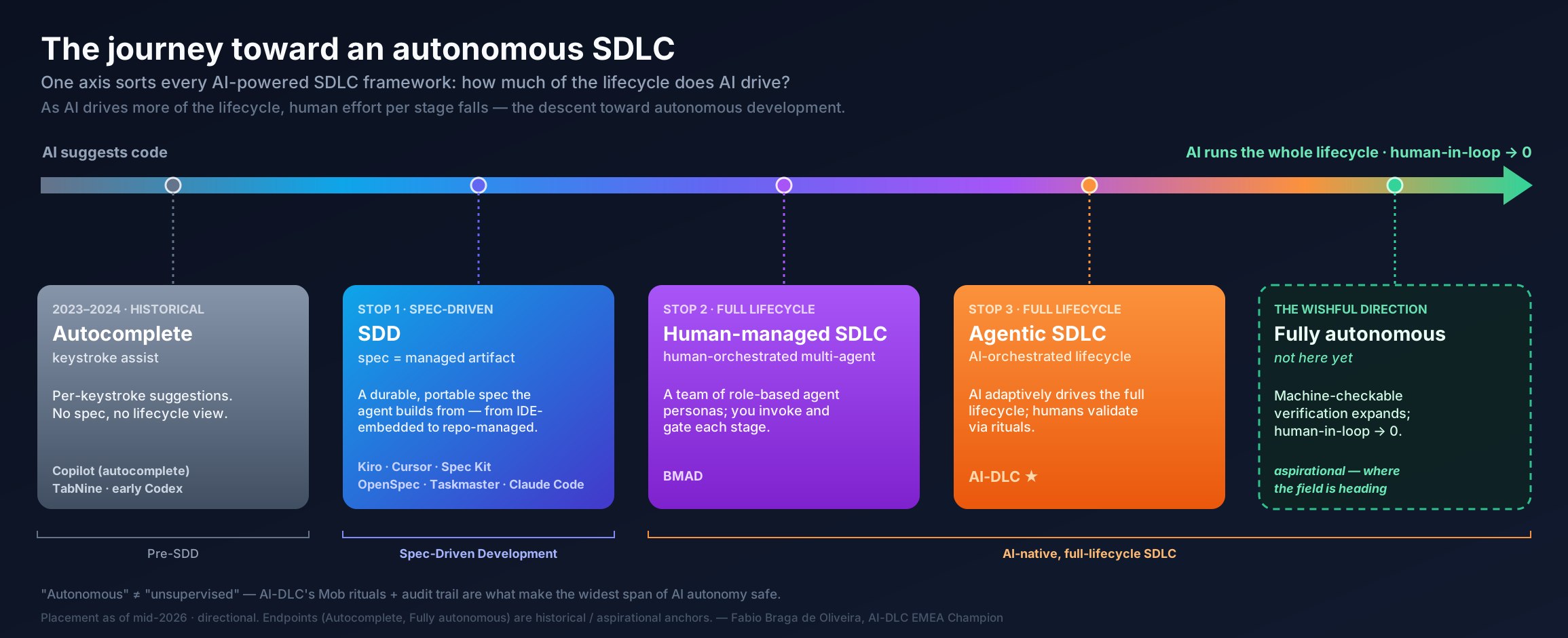 Figure: The journey to an autonomous SDLC — Autocomplete → SDD → Human-managed SDLC → Agentic SDLC, with a fully-autonomous aspirational endpoint. The single axis — how much of the lifecycle does AI drive? — sorts every framework.
We got great coding agents. We didn’t get faster. Link to heading
Here’s the uncomfortable finding. In a randomized controlled trial, METR gave experienced open-source developers access to early-2025 AI tools on real issues in their own repos. The developers believed AI made them about 20% faster. They were actually 19% slower [S19].
That’s not an isolated result. DORA’s 2024 State of DevOps report found the same paradox at the organizational level: a 25% increase in AI adoption correlated with a 1.5% drop in delivery throughput and a 7.2% drop in delivery stability — even as individual developers reported feeling more productive [S20].
The tools got genuinely good. The operating model around them didn’t move. We bolted powerful coding agents onto workflows designed for humans typing every line, and the promised gains largely failed to show up. Tellingly, DORA’s 2025 follow-up saw throughput turn positive — once teams learned how to work with AI [S20]. The missing piece was never model quality. It was process.
That gap is why, across 2025–2026, we suddenly have so many AI-powered SDLC frameworks. They’re all answers to the same question.
A Cambrian explosion of frameworks Link to heading
In barely eighteen months we’ve gone from a handful of tools to a crowded field — Spec Kit, OpenSpec, Kiro, Taskmaster, Cursor, Antigravity, BMAD, AI-DLC. An explosion this sudden is never random: something in the environment shifts and a wave of empty niches opens at once. Four pressures opened these:
1. Two failure modes left a gap in the middle. On one side, AI-assisted coding — autocomplete per keystroke, no view of the lifecycle. On the other, AI-autonomous — “generate the whole app,” no human oversight. Both break at production scale [S3][S1]. Every framework below is filling the middle ground. The specific failure modes they target: intent drift (underspecified prompts), context decay (the agent forgets earlier decisions as the codebase grows), and unverifiable output (no acceptance criteria to check against) [S2].
2. Durable context beats a smarter model. The winning idea is a durable layer underneath the agents: specs and plans that persist across sessions, memory that survives across teammates. That’s what lets AI safely take on more of the lifecycle [S6].
3. The “best” coding agent changes every month. So frameworks compete on being portable planning layers you can carry between agents, rather than betting on one [S4][S7].
4. The industry framing has converged on a single journey: from specs as static planning documents toward AI that drives more and more of the lifecycle [S15]. That journey is the axis everything else sorts on.
The journey: from spec-driven to autonomous SDLC Link to heading
Line every framework up on one axis — how much of the lifecycle does AI drive? — and the noise resolves into a single continuum of increasing AI autonomy. It helps to fix the two ends first, because everything else lives between them:
Spec-Driven Development (SDD) — the specification is the durable artifact and the source of truth. You write and refine a living spec; the agent generates the implementation from it; the spec stays in the repo as living documentation. Scope: plan → build a feature. Lightweight, agent-agnostic, brownfield-friendly. Most SDD tools converge on the same four-phase loop — Specify → Plan → Tasks → Implement — each with a human checkpoint [S2]. AI executes; humans specify and approve.
Autonomous, AI-native SDLC — a full operating model across the classic SDLC phases (requirements & design → build & test → deploy & operate), with human-in-the-loop checkpoints and an audit trail built in. AI plans and executes across the lifecycle; humans decide and validate. Here the methodology and its checkpoints are the product.
Here’s where the major frameworks land:
| Framework | Primary identity | Placement on the journey |
|---|---|---|
| GitHub Spec Kit [S7][S15] | SDD toolkit: constitution → specify → plan → tasks → implement; static markdown specs; 18+ agents | Pure SDD, agent-agnostic (broadest reach) |
| OpenSpec [S4][S12] | SDD planning layer; per-change proposals with spec deltas; strict proposal→apply→archive state machine; specs-in-repo; 20+ tools | Pure SDD, brownfield-first |
| Taskmaster AI [S12] | AI-as-project-manager: parses a PRD into a hierarchical, dependency-aware task graph, hands tasks to any agent; multi-model tiers; Cursor-first via MCP | SDD, decomposition-focused |
| Cursor (Plan Mode + rules) [S13][S15] | IDE-native: read-only Plan Mode drafts spec+plan; .cursor/rules/AGENTS.md act as a lightweight constitution; pseudo-specs, no lifecycle validation | SDD — IDE-embedded (ephemeral, tool-local spec) |
| Kiro (Specs) [S8][S15] | Spec mode in the IDE: requirements/design/tasks in EARS notation; 2026 Requirements Analysis uses SMT solvers to catch contradictions pre-codegen | SDD built into an agent/IDE |
| Google Antigravity [S13] | Agent-first desktop IDE where every action originates from a spec; built for deeply autonomous agents operating under spec constraints | Agentic IDE, spec-constrained autonomy |
| BMAD [S10][S16] | Governed team of role-based agents (Analyst/PM/Architect/PO/Dev/QA/SM) — ~12 in v4, 19+ in v6; two-phase (agentic planning → context-engineered implementation); supports both greenfield and brownfield [S18] | Human-managed SDLC — human-orchestrated multi-agent (you invoke and gate each persona) |
| AI-DLC [S1][S3] | AI-native methodology: Inception/Construction/Operations, Mob rituals, adaptive depth | Agentic SDLC — furthest along; AI-orchestrated full lifecycle (methodology) |
Where AI-DLC lands Link to heading
What it is [S1][S3]: an AI-native methodology developed by AWS’s AI Engineering team that repositions AI from coding assistant to development orchestrator — “AI plans and executes; humans decide and validate.” The methodology was introduced in July 2025 (method paper + first AWS blog); the adaptive workflow scaffolds (Amazon Q Developer Rules and Kiro Steering Files) that implement it were open-sourced in November 2025. It’s a methodology with an open-source reference implementation, not a product.
It sits furthest along the journey for three reasons [S3]:
- Adaptive breadth and depth (“no hard-wired, opinionated SDLC workflows”). AI recommends which stages to run and how deep to go, per intent. Most SDD tools run a fixed pipeline.
- Collaboration as a ritual — Mob Elaboration and Mob Construction, where stakeholders assemble to review and validate AI’s plans and artifacts live.
- Auditability by design — every AI plan, decision, and human approval is logged; documentation-first [S11].
And a crucial clarification: “autonomous” doesn’t mean “unsupervised.” AI-DLC pushes AI to drive the widest span of the lifecycle of any framework here — but the human rituals and the audit trail are precisely what make that autonomy safe. The journey isn’t toward removing humans. It’s toward AI owning execution while humans own decisions and validation.
This isn’t hypothetical — partners are already operating here Link to heading
The clearest sign AI-DLC is more than a thought experiment: global SIs are already productizing it, and the numbers are showing up in AWS’s own AI-DLC customer proof points.
- A global systems integrator has built on it. Wipro — one of AI-DLC’s early adopters — now ships a public Agentic AI SDLC Orchestrator on AWS Marketplace that autonomously drives the lifecycle from ideation through deployment. In AWS partner enablement, Wipro reported using AI-DLC to stand up a production-ready enterprise healthcare-payer platform in roughly 20 hours — with three geographically distributed teams and domain-driven design.
- The proof points repeat across AWS’s AI-DLC adopter stories. A leading Philippines bank built and shipped a new application in two days (a ~50× velocity jump); a leading media network delivered six applications in two days (~4× productivity, ~223 engineer-days saved — roughly ten months of work); and a global ratings-and-analytics provider compressed eight months of work into one week. Different industries, same signal: the gains land when the operating model changes, not just the tool — the mirror image of the METR/DORA paradox that opened this post.
- And from my own seat: across the EMEA partner rollouts I’ve led, the moment AI-DLC “clicks” is almost never the code generation. It’s the first Mob Elaboration — a room of stakeholders watching AI turn a fuzzy intent into a validated plan in minutes — and the audit trail that means no one has to reconstruct why a decision was made three sprints later. The teams that get value are the ones ready to change how they operate, not the ones shopping for a faster autocomplete.
AI-DLC vs. Spec-Driven Development — different altitudes, not competitors Link to heading
The most common confusion I hear is “isn’t AI-DLC just another SDD tool?” No — they operate at different altitudes. SDD lives at the feature altitude (the spec is the durable artifact). AI-DLC lives at the lifecycle altitude (the methodology and its checkpoints are the product). They actually compose: you can run SDD-style specs inside an AI-DLC construction phase.
| Spec-Driven Development | AI-DLC | |
|---|---|---|
| Unit of work | A feature / change [S2] | An end-to-end lifecycle, inception → operations [S3] |
| Source of truth | The living spec in the repo [S2] | The methodology + its logged decisions [S3][S11] |
| AI’s role | Executes from a spec you author [S2] | Plans and executes across stages; drives the loop [S1][S3] |
| Human’s role | Specify & approve each phase [S2] | Decide & validate at rituals (Mob Elaboration/Construction) [S3] |
| Process shape | Mostly a fixed four-phase loop [S2] | Adaptive breadth/depth — AI recommends which stages run (Principle 10) [S3] |
| Onboarding cost | Low — drop into one repo, one feature [S2] | Higher — it’s a team operating model, not a tool [S3] |
Pick SDD when you want a lightweight, agent-agnostic way to make a single team’s coding more reliable — brownfield changes, a feature at a time, spec-in-repo as living documentation. Low ceremony, fast to adopt [S2][S4].
Pick AI-DLC when the bottleneck isn’t code generation but the whole delivery loop — you want AI driving across requirements, design, build, and operations, with explicit human-validation rituals and an audit trail for governance. It asks more of the team (it’s a methodology, not a plugin) but reaches further along the autonomy journey [S1][S3].
In one line: SDD makes your coding trustworthy; AI-DLC makes your whole lifecycle AI-native. Start with SDD for a fast win in one repo; adopt AI-DLC when you’re ready to change how the team operates.
The takeaway Link to heading
Every framework on this map is really answering one question: how much of your lifecycle are you ready to let AI drive? The frameworks aren’t rivals fighting over the same territory — they’re waypoints on a journey from AI-assisted editing to a fully AI-native SDLC, each appropriate at a different level of rigor and ambition.
So here’s the practitioner’s question to sit with: where on that journey is your team ready to operate today — and what’s the one process change that would let you take the next step?
I’d genuinely like to know: how much of your delivery loop is AI driving right now? Reply and tell me where you land on the map.
References Link to heading
- [S1] AI-Driven Development Life Cycle: Reimagining Software Engineering — AWS DevOps Blog. AI-assisted vs. AI-autonomous framing; AI-DLC methodology introduced (31 Jul 2025).
- [S2] Spec-Driven Development: The Definitive 2026 Guide — BCMS. The four-phase loop (Specify → Plan → Tasks → Implement), the three failure modes (intent drift, context decay, unverifiable output), and EARS notation.
- [S3] Open-Sourcing Adaptive Workflows for AI-DLC — AWS DevOps Blog. Open-source scaffolds release; the three challenges, Principle 10, and Mob Elaboration/Construction (29 Nov 2025).
- [S4] OpenSpec — Spec deltas, specs-in-repo, brownfield-first, agent-agnostic planning layer.
- [S6] What is AIDLC? — Augment Code. The durable context layer; context and memory across sessions.
- [S7] GitHub Spec Kit — SDD toolkit: constitution → specify → plan → tasks → implement.
- [S8] Kiro Specs documentation — Requirements/design/tasks, EARS notation, three-phase specs.
- [S10] BMAD Method documentation — Ideation → agentic implementation; specialized role-based agents.
- [S11] How AWS Labs Brings Structure to AI Coding — ELEKS. Documentation-first; human approvals at each stage.
- [S12] Agentic Coding: GSD vs. Spec Kit vs. OpenSpec vs. Taskmaster AI — Rick Hightower (Medium). Tool profiles; Taskmaster multi-model/PM framing; OpenSpec change isolation.
- [S13] Spec-Driven Development: The Definitive 2026 Guide — BCMS. Cursor Plan Mode and Google Antigravity as SDD flavors.
- [S15] 6 Best Spec-Driven Development Tools for AI Coding in 2026 — Augment Code. Static-planning-vs-lifecycle framing; Kiro SMT solver; comparison table.
- [S16] Transforming the Agentic SDLC with BMAD — Sogeti Labs. BMAD role-based agent team; two-phase planning → implementation.
- [S18] BMAD Document Project Workflow — Official BMAD docs. First-class brownfield support: Document Project workflow, brownfield PRD/architecture templates, Test Architect for regression risk.
- [S19] Measuring the Impact of Early-2025 AI on Experienced Open-Source Developer Productivity — METR. Randomized controlled trial: experienced developers were 19% slower with AI, despite believing they were ~20% faster.
- [S20] Accelerate State of DevOps Report 2024 — DORA / Google Cloud. A 25% increase in AI adoption correlated with a 1.5% drop in delivery throughput and a 7.2% drop in stability; the 2025 follow-up shows throughput turning positive as teams learn the operating model.