AI-DLC v2, Part 1: What Actually Changes Link to heading
Most teams have settled into a comfortable arrangement with AI in their software delivery: the model writes code, a human reviews it, and everyone moves on. It works, but it quietly caps how far the automation can go — every stage still waits on a person to say “yes, continue.” The AI-Driven Development Life Cycle (AI-DLC) was built to challenge that ceiling, and its second version, now in preview, sharpens the challenge considerably.
I am an AI-DLC EMEA Champion, so I’ve had hands-on context with both the first release and the v2 preview as it took shape. This post is the first of a three-part series. Here I want to do one thing well: explain what v2 actually changes from v1, and why that change is a genuinely different bet from the rest of the AI-SDLC field. Part 2 covers how you adapt the methodology to your own team without forking it; Part 3 covers the piece I find most compelling — how it learns over time. Some readers will arrive from my earlier landscape post, so let me start with a quick recap for everyone else.
A quick recap: what AI-DLC is Link to heading
AI-DLC is an AI-native software development methodology, created by Raja SP at AWS and open-sourced in November 2025 as a set of adaptive workflow scaffolds — not a product you buy [S1][S3]. Its central move is to reposition AI from coding assistant to development orchestrator. The one-line framing the team uses captures it well: AI plans and executes; humans decide and validate.
The methodology organizes work into three adaptive phases [S2]:
- Inception — the what and why: requirements, user stories, design, units of work, and risk.
- Construction — the how: component design, code and tests, build configuration, and QA.
- Operations — deployment and monitoring.
What set v1 apart was less the phases themselves than three design principles [S3]. First, adaptive depth (its Principle 10): there is no hard-wired pipeline — the workflow expands or contracts to fit the work. Second, collaboration as ritual: practices like Mob Elaboration and Mob Construction make human-AI collaboration a deliberate step, not an afterthought. Third, auditability by design: the process leaves a trail you can inspect. Those principles carry forward into v2. What changes is the machinery underneath them.
The three shifts v2 introduces Link to heading
Reading the README, and the v2 Specification together, three concrete shifts stand out [S2].
First, the workflow layer is now built from composable building blocks. v1 ran a fixed set of stages. v2 keeps the same methodology but rebuilds the layer beneath it around fine-grained, freely arrangeable Skills (following the agentskills.io convention), multi-agent runtimes, deterministic lifecycle hooks, and the Model Context Protocol (MCP) [S12]. Granularity is now expressed natively in the framework rather than bolted on through steering rules alone.
Second, verification became machine-checkable — and that verification is what expands autonomy. This is the core new mental model, and it’s worth slowing down for. Every stage in v2 is structured as a Three-Compartment Construct [S12]:
- C1 — “The What”: the declarative inputs and outputs of the stage; its generation specs.
- C2 — “How do we know it’s right”: the post-conditions the AI self-checks its own output against. These come in two modes. Inferential checks are LLM-judged heuristics — useful, but still requiring human validation. Computational checks are deterministic executables or linters, suited to zero-tolerance rules where “right” is not a matter of opinion.
- C3 — “What did we learn”: corrections made at runtime become candidate rules, which can be promoted into C2 for next time. This is the compounding mechanism — sometimes called compound engineering.
These three compartments are wrapped in a Generate → Verify → Learn loop, with explicit halting conditions — a cap on iterations or a token budget — that escalates to a human when the loop can’t converge on its own. Autonomy is not granted up front; it is earned wherever C2 verification exists.
Third, v2 lays out an explicit, incremental path toward autonomous delivery — gated by that verification maturity. An orchestrator (the spec calls it a conductor) composes stages adaptively, owns the end-to-end goal, enforces the halting conditions and cross-stage invariants, and maintains a full audit trail. Crucially, it does so with no hidden delegation — you can always see what was handed to whom. Autonomy grows only in the areas where verification has matured enough to support it.
If I had to compress v2 into a single sentence, it would be this: reduce human intervention as machine-checkable verification expands. The three shifts all serve that one idea.
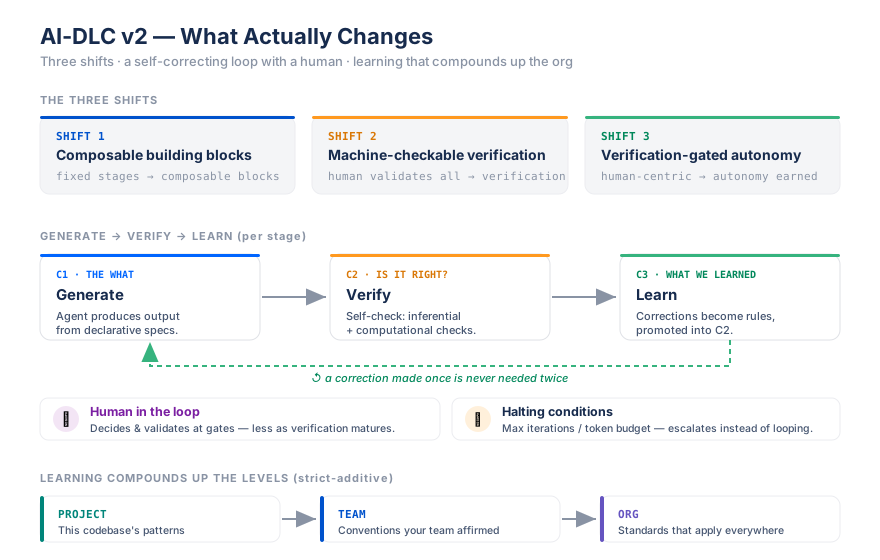 Figure: The three shifts, the Generate → Verify → Learn loop (C1/C2/C3) with the human at the gate, and how a confirmed correction compounds up the project → team → org levels.
Why this bet is different Link to heading
Step back and look across the AI-SDLC landscape, and AI-DLC’s position becomes clear. Other approaches tend to optimize one slice of the problem — a planning artifact like spec-driven development, or a governance wrapper like Tessl. AI-DLC is the only framework I’ve found that explicitly architects a migration path to autonomous delivery gated by verification maturity. It isn’t trying to make the plan better or the guardrails tighter in isolation; it’s trying to answer the harder question of how much of this can safely run without me, and how do I know? The spec frames the goal directly: “AI operates independently within well-defined boundaries; humans are involved only when genuinely needed” [S12].
That is a more demanding claim than “the AI writes better code now,” and it’s why the verification model in the second shift matters so much. Without machine-checkable verification, autonomy is just hope. With it, autonomy becomes something you can extend deliberately, stage by stage, as your confidence is earned rather than assumed.
Where this leaves us Link to heading
v2, in short, keeps the methodology and rebuilds the engine: composable building blocks in place of fixed stages, a three-compartment verification construct that turns “is this right?” into something a machine can check, and an orchestrated, auditable path toward autonomy that only advances as fast as your verification does.
That still leaves the practical question every team asks me: how do I make this mine? v2’s answer is unusually elegant — you reshape the entire lifecycle by writing Markdown files, not by editing framework code. That’s the subject of Part 2.
In the meantime, the question I’d put to you: how much autonomy would you trust your pipeline with today — and what verification would you need in place before you’d extend it further?
References Link to heading
- [S1] AI-Driven Development Life Cycle: Reimagining Software Engineering — AWS DevOps Blog. AI-assisted vs. AI-autonomous framing; AI-DLC origin.
- [S2] awslabs/aidlc-workflows — GitHub. Three-phase workflow; v2 preview: “verifiable, self-correcting engineering workflows.”
- [S3] Open-Sourcing Adaptive Workflows for AI-DLC — AWS DevOps Blog. Principle 10, Mob rituals, self-correcting framing.
- [S12] AI-DLC Workflows 2.0 Specification — part of the awslabs/aidlc-workflows v2 repository. The three-compartment construct (C1/C2/C3), the Generate → Verify → Learn loop, the orchestrator/conductor, and halting conditions.